Product Safety Historical Highlights (P2)
The United States’ Attitude Towards Product Safety
The US was one of the earliest movers to acknowledge consumer protection as a human right. On March 15, 1962, President John F. Kennedy announced the Consumer Bill of Rights to Congress affirming:
(1) The right to safety: to be protected against the marketing of goods which are hazardous to health or life.
(2) The right to be informed: to be protected against fraudulent, deceitful, or grossly misleading information, advertising, labeling, or other practices, and to be given the facts he needs to make an informed choice.
(3) The right to choose: to be assured, wherever possible, access to a variety of products and services at competitive prices; and in those industries in which competition is not workable and Government regulation is substituted, an assurance of satisfactory quality and service at fair prices.
(4) The right to be heard: to be assured that consumer interests will receive full and sympathetic consideration in the formulation of Government policy, and fair and expeditious treatment in its administrative tribunals. (Kennedy, 1962)
It is unlikely that most US citizens today are aware of this powerful list of consumer protections. It went on to inform the 1985 UN Guidelines for Consumer Protection (UNGCP) but failed to ignite the foundational human rights basis needed to enshrine consumer rights as human rights in the US.
Worldwide Recognition of Consumer Rights as Human Rights
Human rights are a manmade construct, living and evolving as society and the world evolves. In the UNESCO Courier in 1977, human rights scholar Karel Vasak (Vasak, 1977) characterized human rights in three generations, conveniently aligning with the French motto: liberté, égalité, fraternité: (1) civil and political rights (first generation, liberté), (2) social, economic, and cultural rights (second generation, égalité), and (3) rights of solidarity (third generation, fraternité). Critics argue that the criteria for Vasak’s tidy generations of human rights fail to accommodate contemporary human rights areas (Domaradzki, Khvostova, Pupovac, 2019), but the framing is helpful from a historical and consumer protection perspective. Consumer protection falls squarely into second generation human rights. Non-digital product safety generally falls under economic human rights. But digital products, as autonomous actors with fuzzy boundaries, touch on all three generations of human rights, amplifying risk of rights violations by digital products themselves, and underscoring the need for greater rigor in assessing these products with which we share our lives.
The 1948 United Nation’s (UN’s) Universal Declaration of Human Rights (UDHR) includes the first two generations of rights, which were further solidified through two UN covenants adopted in 1966 which correspond to Vasak’s first and second generations of human rights, respectively: the International Covenant on Civil and Political Rights (ICCPR) and the International Covenant on Economic, Social and Cultural Rights (ICESCR). These covenants both came into force in 1976.
In the interest of brevity, the thorny question of what precisely qualifies as a human right will not be addressed here. Legal scholar, Sinai Deutch’s analysis of consumer protections as human rights (Deutch, 1994) argues convincingly for recognizing consumer protections as second generation social or economic generation human rights on the basis of satisfying three criteria:
“(1) whether there is an accepted definition of human rights that will assist in establishing consumer rights as human rights?; (2) whether consumer rights fulfil the substantive tests of human rights?; and (3) whether there is a formal basis in international documents for acknowledging consumer rights as human rights?”(Deutch, 1994)
Political philosopher Maurice Cranston defines a "human right is something of which no one may be deprived without a grave affront to justice." (Cranston, 1973) History shows that, in the absence of concerted protections, industry will mistreat people as both laborers and consumers—both grave affronts to justice.
Deutch further asserts that while the UN’s UDHR doesn’t explicitly mention consumer protections, Articles 23 (3) and 25 (1) are synonymous with consumer protections: “the individual's ‘right to just and favourable remuneration ensuring for himself and his family an existence worthy of human dignity’" and the “right to a standard of living adequate for the health and well-being of himself and of his family” (United Nations, 1948). Both articles may be viewed as fundamental economic human rights.
In the ICESCR, consumer protection related economic rights were further explicated in Articles 11 and 12 (United Nations, 1966):
Article 11 (1): The States Parties to the present Covenant recognize the right of everyone to an adequate standard of living for himself and his family, including adequate food, clothing and housing, and to the continuous improvement of living conditions.
Article 12 (1): The States Parties to the present Covenant recognize the right of everyone to the enjoyment of the highest attainable standard of physical and mental health.
President Jimmy Carter signed the covenant in 1977 and sent it to the US congress for ratification, which they failed to do. The US remains the only western democracy to not ratify the covenant and one of only 24 countries (out of 197) to not ratify the covenant. Deutch describes it thusly: “The United States’ position is that human rights include only civil liberties and political rights. This stance refuses to acknowledge economic rights as human rights” (Deutch, 1994). It is perhaps the US’s failure to acknowledge economic rights as human rights that has inexorably led to the gross power and epistemic asymmetries consumers worldwide now face with digital products. This stance must be changed for a future capitalism that doesn’t collapse under the weight of its own exploitive and extractive behaviors.
An even more impactful way that nation states ensure an ongoing commitment to consumer protection as a human right is to include it in their national constitutions. Currently, 64 of 195[1] countries monitored by UN Trade and Development (UNCTAD, 2025) including Mexico, Spain, and most of South America have enshrined consumer rights in their national constitutions. The US of course has not, leaving it subject to the vicissitudes of each new federal administration’s prioritization—or lack thereof— of consumer protections.
From Deutch (Deutch, 1994):
“In a consumer-oriented society, protection of the individual consumer is perceived as part of maintaining human dignity-especially against big business organizations, monopolies, cartels, and multinational corporations. Well-accepted doctrines of human rights, therefore, such as the emphasis on an individual's prosperity, honour, and dignity, can serve as the basis for recognizing consumer rights as human rights. An examination of several basic international and national documents reveals that it is due time to acknowledge consumer rights as human rights.”
Despite much government expense in product safety efforts since the late 19th century, a formal amendment to the constitution has never been proposed. The US’s unwillingness to ratify the UN ICESCR, coupled with the 2010 recognition of the human civil rights[2] of corporations in Citizens United v. Federal Election Commission reflects a pattern of behavior whereby the US government—in bipartisan fashion—continues to prioritize corporate entity rights over human citizen economic and consumer rights.
History of Federal Product Safety Agencies
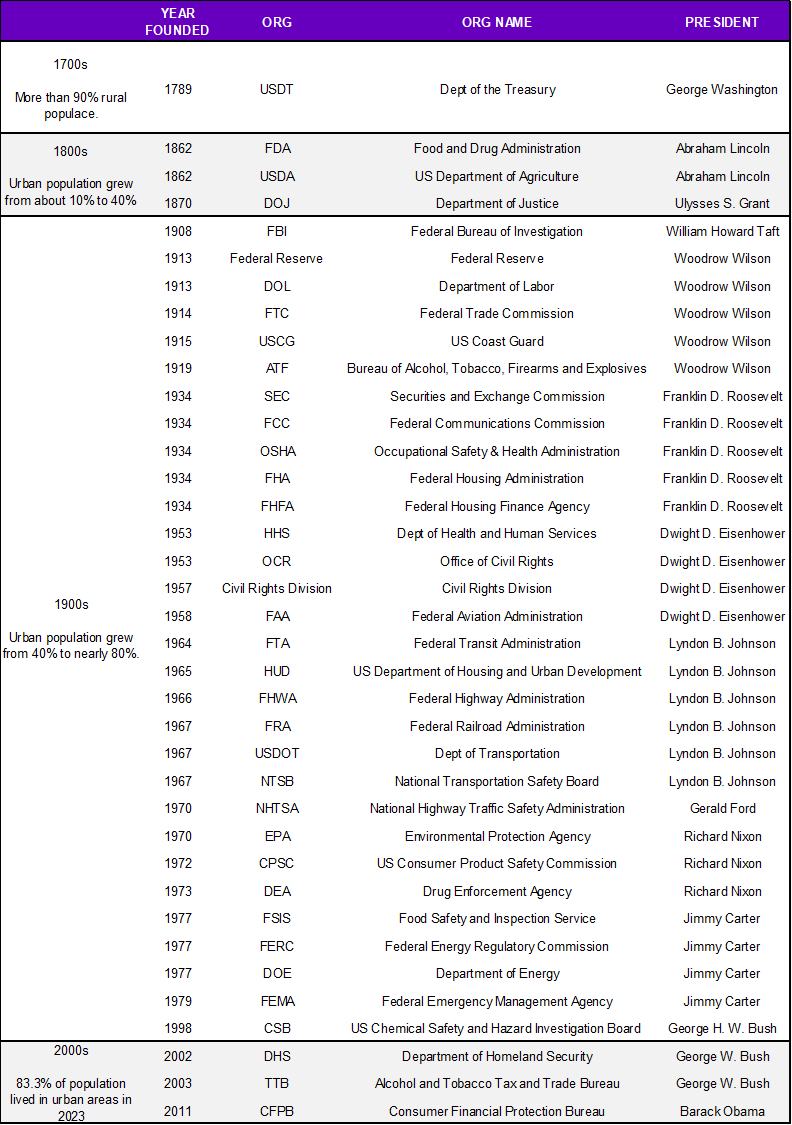
This section examines the history of US federal agencies that play a role in citizen safety. Table 2 shows the chronological timeline of the creation of agencies with safety remits. Two observations are evident from this timeline. First, the shift from an agricultural to a more urban and suburban society corresponds to an increased need for consumer safety protections, and most of those protections are product safety related[3]. Safety regulations follow the arc of consumerism, which mirrors the industrial age’s growth in urban and suburban populations and was further amplified by advertising in the 1950s.
The second observation is that most safety related agencies were created under democratic presidents, but Abraham Lincoln, Dwight D. Eisenhower, and Richard Nixon each ushered in game-changing safety agencies, including two civil rights agencies under Eisenhower, and the Consumer Product Safety Commission and the EPA under Nixon. The push for safety has a timeline of its own, independent of party and presidency, driven by the concerns of citizen consumers. The power of citizens, outraged by industry without accountability producing obviously hazardous products, must not be underestimated. People do not tolerate the reckless hubris and dangerous products of corporations.
Table 2 US Safety Agencies[4]
The US Consumer Product Safety Act
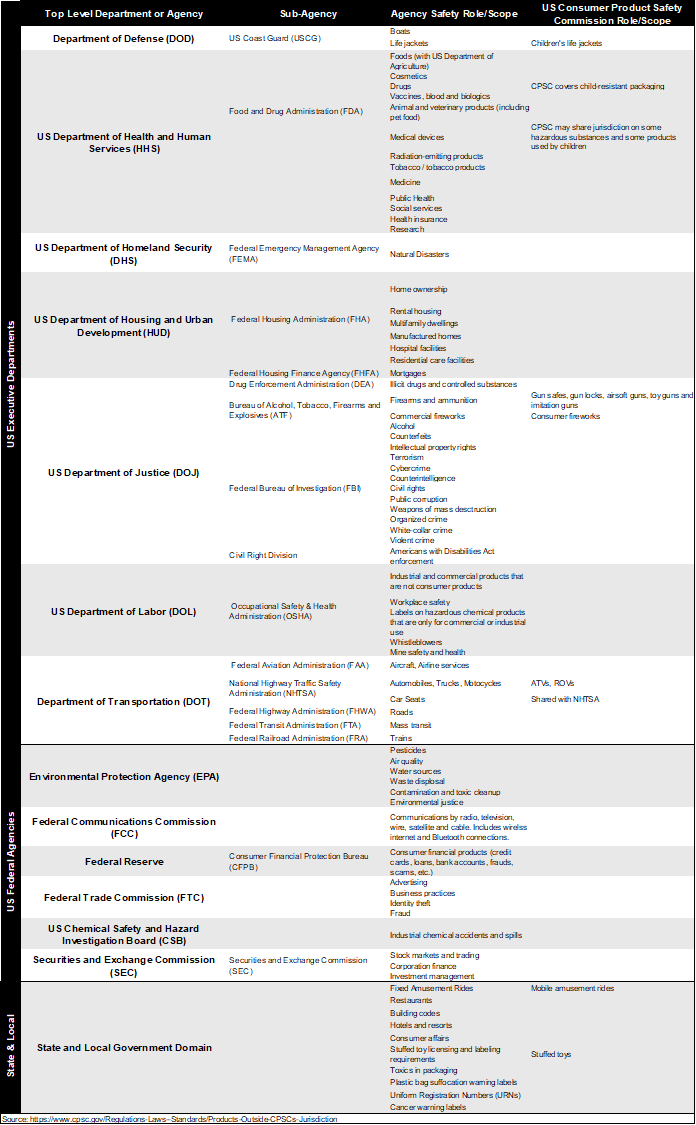
Despite the US’s reluctance to institutionalize economic human rights of citizens, it was the worldwide leader in consumer safety regulation with the 1972 Consumer Product Safety Act (USCPSA), creating the US Consumer Product Safety Commission (USCPSC), an agency endowed with ensuring the safety of consumer products in the US. In practice, however, the USCPSC covers a relatively small portion of consumer products and skews more towards a specific set of general consumer products, particularly those used by children (toys, furniture, etc.). Table 3 shows the products covered by US agencies other than the USCPSC (USCPSC, 2016).
Table 3 US Product Safety Oversight Responsibilities
The most important function of the USCPSC is that they drive product changes, resulting in safer products. The USCPSC tactics to ensure product safety include:
- Issuing mandatory safety standards,
- Product recalls,
- Product bans, and
- Civil penalties.[5]
Note that the USCPSC has no role in products that are ingested or absorbed by humans. The USCPSA was last updated in 2011 and fails to address digital products, leaving their oversight as a patchwork between agencies including the Federal Trade Commission (FTC), the Federal Communications Commission (FCC), the Consumer Finance Safety Board (CFPB), and individual states.
In contrast to this, the European Union (EU) has not only recognized digital products as products, it governs their safety in the General Product Safety Regulation (GPSR) updated in 2023 (EU, 2023). Further, the EU Product Liability Directive of 2024 liability law (EU, 2024) recognizes and governs liability in digital products (De Luca, 2024).
Unfair and Deceptive Practices Statutes
Consumer protection in the US over-indexes on unfair and deceptive practices with widescale adoption of “Unfair and Deceptive Acts or Practices” (UDAP). Though the Federal CFPB (Consumer Financial Protection Bureau’s remit covers “unfair, deceptive, or abusive acts or practices” (UDAAP) (12 U.S. Code Section 5531, 2010). A few states also include abusive acts or practices, but these appear largely in the context of debt collection. (National Consumer Law Center, 2018b).
The FTC’s remit excludes abusive acts or practices: :
“The FTC’s mission is protecting the public from deceptive or unfair business practices and from unfair methods of competition through law enforcement, advocacy, research, and education.” (FTC, 2021)
The key issue is that UDAP oversight and enforcement tends to focus solely on the behavior of the company and agents of the company, whereas product safety necessarily also focuses on the behavior of the product. This distinction is even more important for digital products that behave autonomously by design. For digital products, regulation must cover product behavior as well as corporation behavior. UDAP will thus not result in safer digital products.
As shown in the earlier, the USCPSC is not responsible for a vast number of consumer products, including most digital products.
Moreover, product liability tort law is the remit of the states, even though there is the Uniform Commercial Code, which covers some product quality mandates which most states have adopted (Wikipedia Contributors, 2023).
To summarize then, product safety regulations in the US are:
- Fragmented: overseen and enforced by a disconnected array of federal and state level organizations,
- Incomplete: do not cover digital products,
- Inadequate: focus only on corporate behavior and not product behavior, which is necessary in our digitized world, and
- Poorly enforced: often the penalties are minor annoyances to companies and readily managed in the product cost.
[1] 193 member states and 2 observer states (The Holy See and The State of Palestine; the latter of which does support consumer protections in their constitution). Note also that the counts on the UN website add up to 196—more than the total number of member plus observer states. They erroneously include South Georgia and the Falkland Islands as states [with no answer; the count of “no answer” should be 81 and not 83].
[2] Specifically, upholding the First Amendment human right to protected speech for corporations. The decision essentially grants human status to corporations; a troubling precedent.
[3] Though not addressed in this paper, labor laws are the other “side of the coin” for industrial age human protections, and their growth follows a similar pattern to consumer protections.
[4] Population statistics from: https://www.macrotrends.net/global-metrics/countries/usa/united-states/urban-population
[5] The USCPSC has issued only 59 criminal penalties from 2007 to 2018, [https://www.gao.gov/blog/what-consumer-product-safety-commission,-and-how-does-it-protect-consumers-hazards] but civil penalties are capped at $120,00 per act, and up to $17,150,000 for a series of related violations. [https://www.federalregister.gov/documents/2021/12/01/2021-26082/civil-penalties-notice-of-adjusted-maximum-amounts]