A brief history of key regulated products in the US (P3)
Products with intrinsic safety risks have been of concern to US citizens since the birth of the country. For this paper, alcohol, tobacco, food, medicine, automobiles and airplanes were examined, particularly their US product introduction, mass production, and product safety histories. Table 4 summarizes key milestones: (a) the earliest date of product introduction, (b) the year of commercial relevance in the US, which is intended to reflect mass consumer availability and a critical mass of adoption, (c) highlights of federal product safety regulation, (d) highlights of federal product labeling regulations, and (e) the lag between product mass availability/adoption and product safety.
Table 4 Product Safety Lag
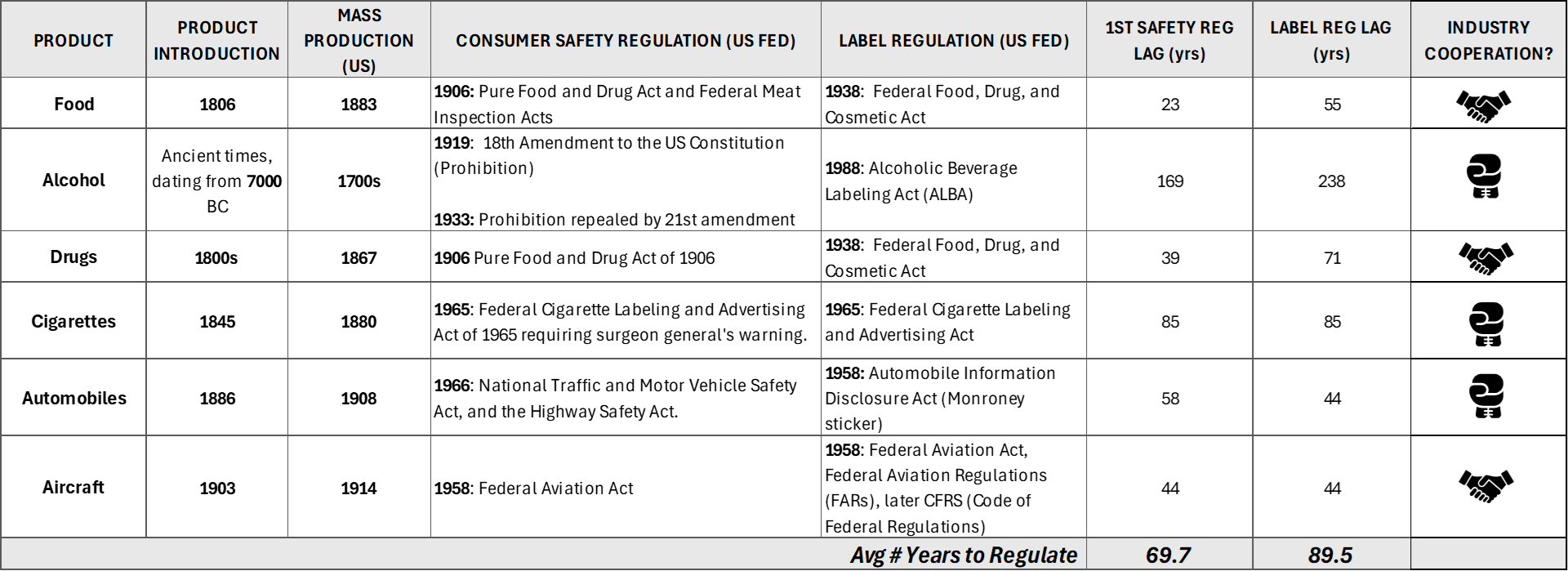
The industry cooperation column reflects relative cooperation of the industry towards product safety measures. Three of the six studied industries actively resisted safety regulation of their products: alcohol, cigarettes and automobiles. Food, drug, and aviation industries were more cooperative[1]. Food and drug industries had an appearance of less resistance due to their first-mover status with respect to safety regulation, whereas the aviation industry embraced safety governance likely due to the potential for loss of life, as witnessed by the immediate response for regulation following the first US mid-air collision over the Grand Canyon in 1956. Regulation followed briskly in 1958 Federal Aviation Act.
Food and drugs were the first products to have safety regulations in the US. The first case of food safety regulation was the 1784 Massachusetts Act Against Selling Unwholesome Provisions which prohibited the sale of “diseased, corrupted, contagious or unwholesome provisions, whether for meat or drink, knowing the same, without making it known to the buyer.” (State of Massachusetts, 1784) The first two federal product safety laws were also food and drugs, respectively: the Drug Importation Act of 1848 and the Tea Importation Act of 1897, which governed the ingredients and quality of imported drugs and tea, respectively. In Table 1, digital products were ordered according to their degree of integration. Consumables like food and drugs are of course highly integrated. Integrable products are intuitively understood to have high safety risks to consumers, so it is not surprising that food was one of the earliest product to have safety regulation.
Another key finding from the history of the six product categories is that the average lag between product mass availability and the earliest product safety regulation was nearly 70 years (69.7 years). The average lag between product introduction and safety labels was nearly 90 years (89.5 years). However, the inclusion of alcohol in the average skews the data. Alcohol consumption has been a cultural norm, being mass-produced and sold for centuries. In the settling of the US, alcohol was a safer choice than drinking water (Crews, 2007) and early colonists consumed about 3.5 gallons of alcohol per year (Gershon, 2016). Excluding alcohol from the calculation, the average lag between product mass availability and product safety regulation is 49.8 years, and 59.8 years between the start of mass production and product labeling regulation (Table 5).
Table 5 Product Safety Lag - Sans Alcohol
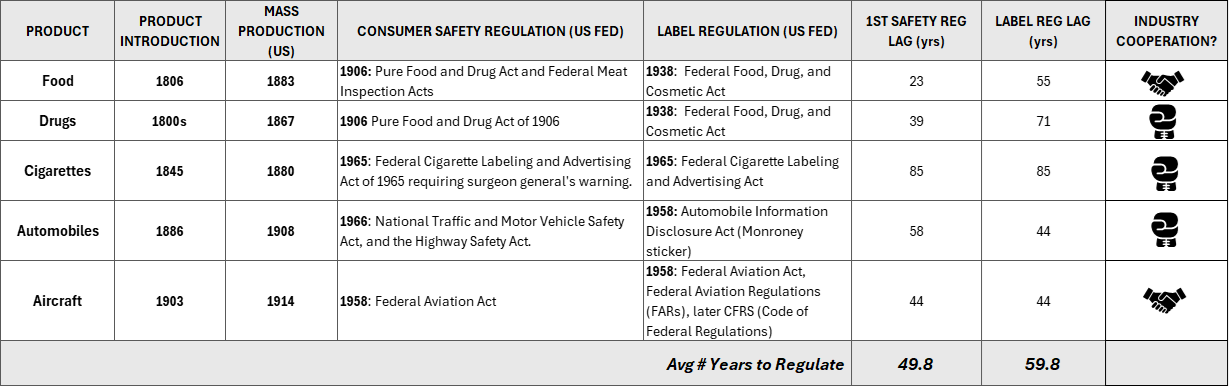
Another interesting observation is that both the automobile and cigarette industries saw label regulation before product safety regulation. However, the cigarette manufacturers championed cigarette warning label as an effort of controlling the regulation (Hilts, 1996), but the Monroney automobile sticker [label] was motivated by animosity between automobile dealerships seeking greater pricing transparency from manufacturers (Severson, 2025).
[1] Though the food industry seems to be ramping up resistance in light of increased obesity and Type 2 diabetes rates (Brownell and Warner, 2009).